
The following article is from the Sioux City Dispatch and gives a good idea of Lizzie’s day during the trial. It was said, perhaps due to her recovering from bronchitis, that she slept up on the second floor of the Warden’s house after her first night in the infirmary. and not on the cell block. .
"As his son I am proud of hisefforts to succeed in life"Jefferson Randolph Smith IIIArtifact #93-2Jeff Smith collection(Click image to enlarge)
oapy's son hires a legal firm to stop the defamation of his father's name.
At age 30, Jefferson Randolph Smith III, Soapy and Mary's oldest son, was protecting his father's legacy and his mother's reputation from "libel" and scandal. He was also
Welcome to this week's Link Dump!I'm sure our host this week needs no further introduction. The caption says it all.A medieval anti-war satire.Mysterious meat shower? Or vulture vomit?The paranormal side of the Cold War.Ernest Hemingway, boxing, and, uh, salad dressing.The man who blew up a nuclear power station.Mystery in a medieval tomb.More proof that scientists have way too
Youth With Executioner by Nuremberg native Albrecht Dürer … although it’s dated to 1493, which was during a period of several years when Dürer worked abroad. November 13 [1617]. Burnt alive here a miller of Manberna, who however was lately … Continue reading →
In 1830, Joseph Knapp conspired with his brother, John Francis Knapp, to hire a local criminal, Richard Crowninshield, to murder their great uncle, Captain Joseph White, in Salem, Massachusetts. They believed that if the captain died without a will, they stood to inherit a sizable fortune.Read the full story here: "A Most Extraordinary Case"
Say what you want about Robert Moses. But as Parks Commissioner in the 1930s, he opened 11 new public municipal pools across the five boroughs—helping residents keep cool and resist the lure of swimming in the East or Hudson River, which amazingly people used to do. Moses, a swim fan himself, also championed and helped […]
[Editor’s note: Guest writer, Peter Dickson, lives in West Sussex, England and has been working with microfilm copies of The Duncan Campbell Papers from the State Library of NSW, Sydney, Australia. The following are some of his analyses of what he has discovered from reading these papers. Dickson has contributed many transcriptions to the Jamaica […]
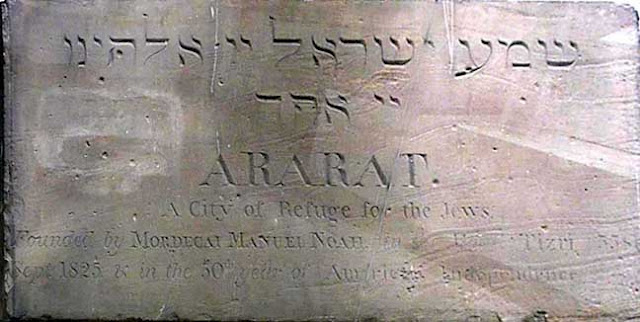
“Hear, O' Israel, The Lord is our God-The Lord is One. ARARAT, a City of Refuge for the Jews, founded by Mordecai Manuel Noah, in the Month of Tizri, September 1825, and in the 50th year of American Independence"
[more]
Mordecai Manuel Noah
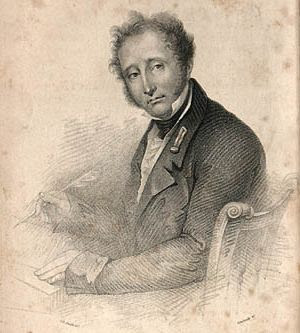
Mordecai Manuel Noah had been a major in the Pennsylvania Militia, U. S. Consul to the Kingdom of Tunis, Sheriff of New York, a playwright, a publisher, and a high-ranking Tammany Hall politician. In the 1820s Noah was easily the most well-known and politically powerful Jewish man in America. He was also the kind of flamboyant eccentric that has always been popular in New York City.
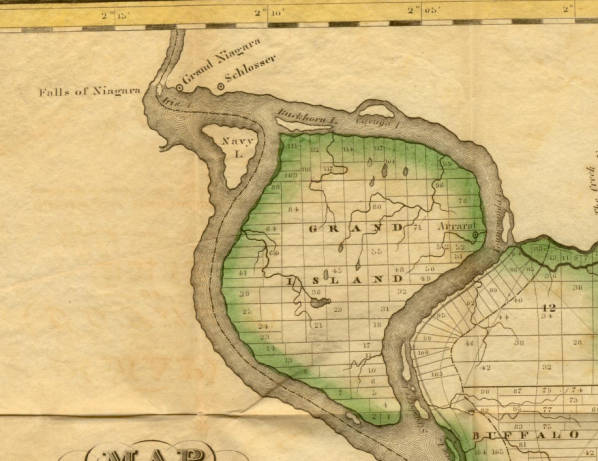
Noah’s most audacious move was his attempt to establish a homeland, or at least a “City of Refuge” for Jews in America. The idea was at least five years in the planning, with the first practical steps taken in 1825 when Samuel Leggett, acting on Noah’s behalf, purchased 2,555 acres on Grand Island, in the Niagara River. Noah then published his intention to found the city of Ararat—named after the resting place of Noah’s Ark—as a Jewish homeland.
A 300 pound cornerstone was created for the new community and it was to be dedicated on Grand Island in September 1825. The organizers could not find enough boats to carry the expected crowd to the island, so the cornerstone was dedicated at St. Paul’s Episcopal Church in Buffalo. Noah was a Royal Arch Mason and it is believed that Episcopal cooperation was obtained through his masonic connections. On September 2, Mordecai Noah, wearing a Richard III costume and gold medallion borrowed from New York’s Park Theatre, led a procession that included a military band, an assembly of Freemasons, and a number of city officials. Also atttending was the great Seneca Chief, Red Jacket. Noah believed – as the Mormons later would— that American Indians were descendants of the lost tribes of Israel.
The cornerstone was laid on the communion-table, and cups filled with wine, corn and oil were placed on top of it. The stone was consecrated using both Hebrew and Episcopal rites. Following the consecration, Noah delivered a speech proclaiming himself “by the Grace of God, Governor and Judge of Israel” and announcing a re-organization of the Jewish government. He offered Ararat as an asylum to Jews throughout the world and at the same time levied a tax of three Shekels (one dollar) in silver on every Jew throughout the world, to capitalize the new venture and aid in the settlement of emigrants to the new community.
Grand Island, New York
In spite of its grandiose beginnings, Ararat was a profound failure for a number of reasons. Noah had not consulted with Jewish leaders and his ideas had very little support. In America the Jewish community feared the venture would prove disreputable. In Europe, where Noah hoped to get most of his settlers, the idea was ridiculed from all corners. Adding to Noah’s woes, the “Morgan Affair” the following year—in which Freemasons were accused of kidnapping and killing William Morgan for revealing their secretes—led to fervent anti-Masonic sentiment in Western New York. The Freemasons’ very visible support of Ararat raised public suspicion of the project.
The cornerstone never made it to Grand Island and it is doubtful whether Noah ever did either. Since 1825 it has been a matter of debate whether Noah was sincerely trying to establish a Jewish homeland or if it had all been a real estate scheme. Letters discovered later indicate that it was a little of both. Mordecai Noah’s support of Zionism never faltered, but in 1825 he was well aware of the value of the property at the mouth of the Erie Canal which opened later that year, and he hoped to make a sizeable profit in land sales.
Sources:
Johnson, Paul E., and Sean Wilentz. The Kingdom of Matthias: a story of sex and salvation in 19th-century America. updated ed. New York: Oxford University Press, 2012
"We follow vice and folly where a police officer dare not show his head, as the small, but intrepid weasel pursues vermin in paths which the licensed cat or dog cannot enter."
The Sunday Flash 1841