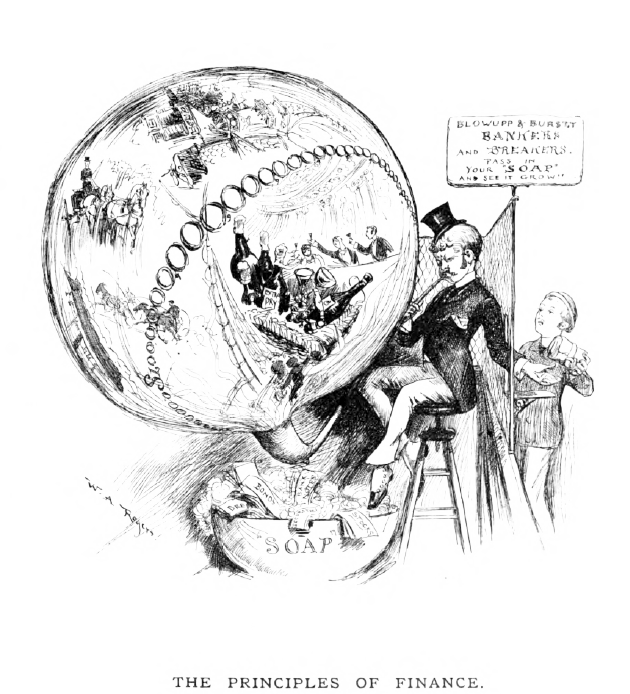

It's time for this week's Link Dump!Let's dance!That time when an English village was terrorized by a giant rabbit.How the Declaration of Independence made the news.The socialite and the "Titanic orphans."The last victim of the Berlin Wall.Remembering the American Soapbox.Life on one of Lord Nelson's 32-pounders.The hidden communication of animals.British fairies, meet Indian changelings.3I
Riverside Drive is one of Manhattan’s most beautiful and dramatic avenues. It’s also a place of legend and mystery, especially during the Drive’s early decades as a Gilded Age “millionaire colony” rival to Fifth Avenue. Which mansion built in the early 1900s has a basement tunnel leading to the Hudson River? Where can you find […]
"As his son I am proud of hisefforts to succeed in life"Jefferson Randolph Smith IIIArtifact #93-2Jeff Smith collection(Click image to enlarge)
oapy's son hires a legal firm to stop the defamation of his father's name.
At age 30, Jefferson Randolph Smith III, Soapy and Mary's oldest son, was protecting his father's legacy and his mother's reputation from "libel" and scandal. He was also
It's time for this week's Link Dump!Let's dance!That time when an English village was terrorized by a giant rabbit.How the Declaration of Independence made the news.The socialite and the "Titanic orphans."The last victim of the Berlin Wall.Remembering the American Soapbox.Life on one of Lord Nelson's 32-pounders.The hidden communication of animals.British fairies, meet Indian changelings.3I
Whatever you believe about the guilt or innocence of Lizzie Borden, I have always believed film makers do a great injustice to the story by not beginning at the beginning- the death on March 26, 1863 of the first Mrs. Borden. In the dying moments of Sarah Morse, Emma takes on the weight of the care of her little sister, not yet three years old. Emma herself was just 12 on March 1st. Emma has seen her mother suffer for a long time, seen her pain and loss of little Alice Esther. Emma is old enough
"As his son I am proud of hisefforts to succeed in life"Jefferson Randolph Smith IIIArtifact #93-2Jeff Smith collection(Click image to enlarge)
oapy's son hires a legal firm to stop the defamation of his father's name.
At age 30, Jefferson Randolph Smith III, Soapy and Mary's oldest son, was protecting his father's legacy and his mother's reputation from "libel" and scandal. He was also
(New York Journal, May 31, 1896.)On the
morning of Memorial Day, May 30, 1896, Mrs. Annie Cunningham had to go to work,
while her 13-year-old daughter, Mary (known as Mamie), was home from school for
the holiday. Mrs. Cunningham asked Mamie if she planned to go to the parade.
Mamie said no, she wasn’t interested, and she planned to do housework and
study. At 8:30, she said goodbye to her daughter
Riverside Drive is one of Manhattan’s most beautiful and dramatic avenues. It’s also a place of legend and mystery, especially during the Drive’s early decades as a Gilded Age “millionaire colony” rival to Fifth Avenue. Which mansion built in the early 1900s has a basement tunnel leading to the Hudson River? Where can you find […]
Whatever you believe about the guilt or innocence of Lizzie Borden, I have always believed film makers do a great injustice to the story by not beginning at the beginning- the death on March 26, 1863 of the first Mrs. Borden. In the dying moments of Sarah Morse, Emma takes on the weight of the care of her little sister, not yet three years old. Emma herself was just 12 on March 1st. Emma has seen her mother suffer for a long time, seen her pain and loss of little Alice Esther. Emma is old enough
Anthony Comstock, founder of The New York Society for the Suppression of Vice, was on a personal mission to protect America’s youth from any art or literature which he deemed objectionable. His name became so tightly bound to the war on smut that one of Comstock’s famous targets, George Bernard Shaw, named this peculiarly American censorship crusade, “Comstockery.”
Anthony Comstock
Comstock first became interested in dirty books in1868 after a friend of his contracted a venereal disease from a visit to a brothel. Comstock believed that his friend’s moral downfall had begun with the purchase of an obscene book. He paid a visit to the bookseller, purchased and obscene book himself, then reported the transaction to the police and had the seller arrested.
NYSSV
Comstock repeated this operation in bookstores throughout New York City and in 1872 he got the attention of the Young Men’s Christian Association, whose Committee for the Suppression of Vice was perusing an anti-smut campaign of its own. The committee funded Comstock’s crusade and eventually became an independent organization, New York Society for the Suppression of Vice, with Comstock as its head. The NYSSV became a quasi-official law enforcement organization and under its aegis, Comstock arrested at least three thousand people for obscenity.
The campaign was begun to protect American youth from the corrupting influence of lower-class pornography, but Comstock soon realized that some literary classics also contained corrupting influences. He expanded his campaign against smut to include authors such as Ovid, Boccaccio, and Walt Whitman. When it became clear that not all of Comstock’s financial backers would agree to the banning of classics, Comstock explained that it was not the works, per se, that were objectionable, but how they were presented to the public, saying:
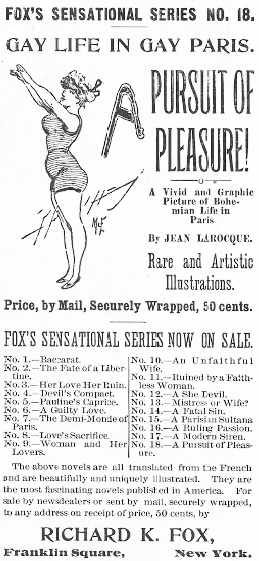
“These works, heretofore carefully concealed from public view, and kept by booksellers only to meet what some consider the legitimate demand of the student, or gentlemen’s library, are now advertised and sold by certain parties as “rich, rare, and racy” books, “amorous adventures,” “spicy descriptions,” “love intrigues on the sly,” etc.”
Comstock had a similar approach to the visual arts: he did not object to elite society viewing nude paintings in the context of a museum, but when a gallery began selling photographic reproductions of nude paintings to the masses, he shut them down.
In 1873 Comstock and his organization sponsored a set of federal laws—commonly known as the “Comstock Laws”—which made it a federal crime to send “obscene, nude or lascivious” material through the U. S. Mail. This included information about birth control and abortion. Anthony Comstock was appointed a special agent of the Post Office to enforce the laws.
While publications like The National Police Gazette still routinely ran advertisements for racy pictures, abortifacients, and rubber goods (condoms), Comstock claimed to have seized 130,000 pounds of books, 194,000 “bad” pictures, 5,500 indecent playing cards, and 3,150 pills and powders used by abortionists, in the first year alone.
Expanding the campaign to include birth control and abortion set him against a whole new class of notorious opponents. Pretending to be seeking birth control information for his wife, Comstock entrapped Madame Restell, New York’s most infamous abortionist. While out on bail she committed suicide by cutting her throat. He brought legal proceedings against George Bernard Shaw and got the city of New York to ban Margaret Sanger’s work on family planning. When free love advocate, Victoria Woodhull, published a story charging Reverend Henry Ward Beecher with adultery, Comstock had her arrested. Woodhull, who at the time was the presidential candidate for the short-lived Equal Rights Party, had to spend Election Day in jail.
Comstock fought his last battle in San Francisco while attending the International Purity Congress. He initiated prosecution against a San Francisco department store for dressing nude mannequins in the store window in public view. He lost the case and never recovered from the ridicule that it generated.
Though Anthony Comstock died in 1915, his laws lived on. The Comstock Laws were not fully repealed until the 1990s.
Sources:
Beisel, Nicola Kay. Imperiled Innocents: Anthony Comstock and family reproduction in Victorian America. Princeton, N.J.: Princeton University Press, 1997.
Miller, Neil. Banned in Boston: the Watch and Ward Society's crusade against books, burlesque, and the social evil. Boston: Beacon Press, 2010.
Sante, Luc. Low life: lures and snares of old New York. New York: Farrar Straus Giroux, 1991.
"We follow vice and folly where a police officer dare not show his head, as the small, but intrepid weasel pursues vermin in paths which the licensed cat or dog cannot enter."
The Sunday Flash 1841