

Said She Would and Did.


Tag: Disaster
A Bird of Prey.
An enterprising eagle carries off a child in Florida.

Another Steamboat Disaster.
The Steamboat "Riverdale" Blown Up in the Hudson.
The Modern Builder.
A Woman Rescued from the Jaws of a Catamount.
Davy Crockett's Almanack, 1838.
Burning of Steamers at Cincinnati.
Burning of Steamers on the Ohio River at Cincinnati May 17, 1869.
Foundering of the Titania.
One of the most thrilling disasters at sea that has happened for many years.
Afloat on a Cake of Ice.
Perilous Situation of a Skating Party on the Ohio River Near Zanesville, Ohio.
Thrilling Railroad Accident.
Startling accident at the draw bridge of the Rensselaer and Saratoga Railroad, Federal Street, Troy, N. Y., Saturday, Sept 23.
Another Steamboat Disaster.
New York City, -- The Steamboat Riverdale blown up, August 28th – Rescuing the passengers.
Eaten by Sharks.
In the Jaw of the Man-Eaters. James E. Hamilton of Lake Worth, Florida, is Devoured by Sharks.
The Southern Pacific Railway Disaster.
Her Last Ascent.
Gertie Carmo, a Female Aeronaut and Trapeze Performer, Hurled to the Ground and Instantly Killed in Detroit, Mich.
A Plucky Elberon, N. J., Girl
Caroline Burned!
The Astor Place Riot
Terrible Struggle with Flame and Flood
The burning of the steamer John H. Hanna near Plaquemine, Louisiana, by which thirty lives were lost
Chorus Girls in a Panic.
An unruly horse causes great excitement in the Metropolitan Opera House, this city.
Strange Company - 10/23/2026
Early American Crime - 2/7/2019

Soapy Smith's Soap Box - 10/13/2025
Murder By Gaslight - 10/24/2026
Executed Today - 11/13/2020
Mdlle. Carlotta de Berg. | Surf Swimming at Hawaii, Sandwich Islands.
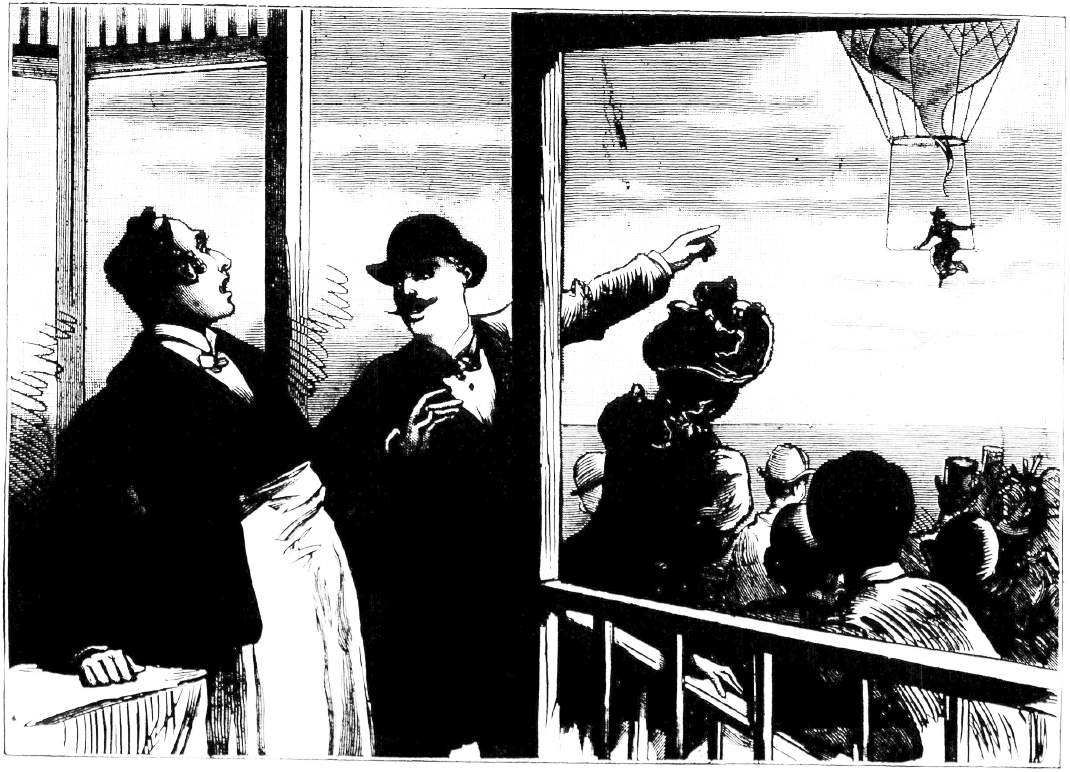
Said She Would and Did.

Mrs. Cary cures her husband of flirting by ascending in a balloon at Buffalo, N. Y.
Head Waiter Cary at the restaurant at Crystal Beach, Buffalo, N. Y., has experienced the novel sensation of seeing his wife leave him by the balloon route. And a more surprised man could not have been found between dawn and sunset. Cary is a “masher” and has kept his wife and babies in the background while he carried on flirtations with the fair diners at his table.
Mrs. Cary had a quarrel with her spouse lately, which ended in a threat that she would leave him for a home beyond the skies. The other afternoon a big crowd assembled to see the balloon ascension. Just before the gas bag was filled Mrs. Cary trundled the baby over in its carriage and left it with her husband. The next Cary heard was the shout: “Cary, there goes your wife.” Cary looked up and say to his amazement, hanging to the balloon the wife of his bosom. She seemed self-possessed on her aerial perch, and waved adieu to the crowd as she ascended.
He stood as if transfixed, unable to utter a cry. Presently the balloon was checked in its skyward course and then to his consternation the deserted husband saw his better half cut loose from the airship and drop with a parachute to the earth. She landed only a few rods from her starting place. She was not half so scared as her husband and it is safe to say Cary will not flirt again until he recovers from his fright.
National Police Gazette, September 16, 1893.
Welcome to the National Night Stick
"We follow vice and folly where a police officer dare not show his head, as the small, but intrepid weasel pursues vermin in paths which the licensed cat or dog cannot enter."The Sunday Flash 1841



- 1810s
- 1820s
- 1830s
- 1840s
- 1850s
- 1860s
- 1870s
- 1880
- 1880s
- 1890
- 1890s
- Abduction
- Abortion
- Accident
- Actors
- Adultery
- Advertisement
- African Americans
- Alabama
- Alcohol
- Allan Pinkerton
- America
- Animal
- Assault
- Axe Murder
- Bank Robbery
- Barnum
- Baseball
- Beer
- Bet
- Bicycle
- Billiards
- Bio
- Boston
- Boxing
- Boys
- Broadway
- Brooklyn
- Brothel
- Buffalo
- Burglar
- Burglary
- Burlesque
- California
- Canada
- Cartoon
- Censorship
- Chicago
- children
- Chorus Girls
- Christmas
- Cincinnati
- Civil War
- Clergy
- Clubbing
- College
- Colorado
- Comstock
- Con Game
- Connecticut
- Counterfeit
- Court
- Cowboy
- Crime
- cross-dressing
- Crossdressing
- Cursing
- Dancing
- Deception
- Delinquents
- Denver
- Detectives
- Detroit
- Dime Novels
- Disaster
- Disguise
- Disorderly conduct
- Divorce
- Domestic Violence
- Drowning
- Duel
- Editorial
- Election
- Entertainment
- Event
- Fad
- Family
- Fashion
- Fight
- Fire
- Florida
- Food
- Football
- Forger
- Fraud
- Gambling
- Gangs
- Georgia
- Great Detectives
- Gunshot
- Hoax
- Holiday
- Horses
- Hotel
- Illinois
- Indiana
- Insanity
- Jail Break
- Jealousy
- Justice
- Kansas
- Kentucky
- Little Murders
- Louisiana
- Lynching
- Maine
- Marriage
- Maryland
- Massachusetts
- Medicine
- Michigan
- Minnesota
- Missouri
- Montana
- Murder
- Music
- Nevada
- New Hampshire
- New Jersey
- New Orleans
- New Year
- New York
- New York City
- Newsboys
- Newspaper
- Nudity
- Obscenity
- Ohio
- Opium
- Pennsylvania
- Performer
- Petrified man
- Photography
- Pickpocket
- Poisoning
- Police
- Police Gazette
- Politics
- Prank
- Prison
- Prostitution
- Railroad
- Rape
- Rats
- Reform
- Religion
- Reporters
- Revenge
- Rhode Island
- Robbery
- Romance
- Saloon
- San Francisco
- Scandal
- Science
- Seasonal
- Sex
- Slashing
- Society
- Spiritualism
- Sport
- Sports
- Spousal Abuse
- St. Louis
- Stabbing
- Steamboat
- Steamship
- Stock Broker
- Suicide
- Summer
- Tammany Hall
- Temperance
- Tennessee
- Texas
- Theatre
- Theft
- Thomas Byrnes
- Valentine
- Vigilantes
- Voyeur
- War
- Washington D.C.
- Wife beaters
- Winter
- Women