No. 483
Crime, Eccentricity, and the Sporting Life in 19th Century America.
August 20, 2019

Comstockery.

Anthony Comstock was on a personal mission to protect America from vice.
August 20, 2019
...
...

Tag: Jealousy

A Jealous Husband’s Mistake.

How a Reading, PA., merchant, broke open his wife’s charmer and discovered a supposed lover to be a harmless female cousin.

2/19/2018

The Green-Eyed Monster.

10/14/2014

Bloody Duel over a Woman.

J. Williams and A. Jabes, two Salt Lake City, Utah, Men, carve each other in a frightful manner.

11/19/2013

What Led to a Divorce.

What a Husband Discovered, and How a couple were separated.

5/20/2013

A Fiendish Husband’s Desperate Deed.

10/16/2012
William Bell Scott, Woman Startled by the Ghost of a Girl by a MirrorSecond marriages can be awkward, especially when the ex-spouse has issues with their former partner entering into a new union.  If said ex-spouse happens to be dead, you know your domestic life has well and truly entered Strange Company territory.In her 1974 book “Haunted East Anglia,” Joan Forman described an unsettling
More...
Strange Company - 6/15/2026
"As his son I am proud of hisefforts to succeed in life"Jefferson Randolph Smith IIIArtifact #93-2Jeff Smith collection(Click image to enlarge) oapy's son hires a legal firm to stop the defamation of his father's name. At age 30, Jefferson Randolph Smith III, Soapy and Mary's oldest son, was protecting his father's legacy and his mother's reputation from "libel" and scandal. He was also
More...
Soapy Smith's Soap Box - 10/13/2025
Getting around the western Bronx by foot means encountering hilly streets, lots of hilly streets. The pitched terrain comes from ridges of bedrock formed millions of years ago extending into Northern Manhattan. Back in the early 1900s when the Bronx was undergoing urbanization, all these hills posed a challenge to transit engineers, since some roads […]
More...
Ephemeral New York - 6/15/2026
Youth With Executioner by Nuremberg native Albrecht Dürer … although it’s dated to 1493, which was during a period of several years when Dürer worked abroad. November 13 [1617]. Burnt alive here a miller of Manberna, who however was lately … Continue reading
More...
Executed Today - 11/13/2020
 Stephen Pettus gave Hannah Southworth a glass of drugged champagne and had his way with her while she was unconscious. Hannah became pregnant and for years after, she badgered Pettus to acknowledge that he had ruined her. When all legal means were exhausted, she avenged her honor by shooting him in the back on a Brooklyn street.Read the full story here: Avenging Her Honor.
More...
Murder By Gaslight - 6/13/2026
Be sure to stop by our Facebook page tomorrow for a Prosecution Marathon of witnesses. Here are the witnesses for Wednesday, June 14th, Day 9 Rufus Hilliard, City Marshal, Mayor John Coughlin, Mrs. Hannah Gifford (seamstress and dressmaker), Anna Borden ( wealthy socialite who was on Lizzie’s grand tour of Europe, distantly related to Lizzie), Lucy Collett (watching the office of Dr. Chagnon day of the murder), Thomas Bowles ( handyman who once rented a room from Addie Churchill and was wa
More...
Lizzie Borden: Warps and Wefts - 6/13/2026
  [Editor’s note: Guest writer, Peter Dickson, lives in West Sussex, England and has been working with microfilm copies of The Duncan Campbell Papers from the State Library of NSW, Sydney, Australia. The following are some of his analyses of what he has discovered from reading these papers. Dickson has contributed many transcriptions to the Jamaica […]
More...
Early American Crime - 2/7/2019
The Feejee Mermaid. | Sharkey Escapes!

Comstockery.

Anthony Comstock, founder of The New York Society for the Suppression of Vice, was on a personal mission to protect America’s youth from any art or literature which he deemed objectionable. His name became so tightly bound to the war on smut that one of Comstock’s famous targets, George Bernard Shaw, named this peculiarly American censorship crusade, “Comstockery.”

comstock Anthony Comstock

Comstock first became interested in dirty books in1868 after a friend of his contracted a venereal disease from a visit to a brothel.  Comstock believed that his friend’s moral downfall had begun with the purchase of an obscene book. He paid a visit to the bookseller, purchased and obscene book himself, then reported the transaction to the police and had the seller arrested.

NYSSV NYSSV

Comstock repeated this operation in bookstores throughout New York City and in 1872 he got the attention of the Young Men’s Christian Association, whose Committee for the Suppression of Vice was perusing an anti-smut campaign of its own. The committee funded Comstock’s crusade and eventually became an independent organization, New York Society for the Suppression of Vice, with Comstock as its head. The NYSSV became a quasi-official law enforcement organization and under its aegis, Comstock arrested at least three thousand people for obscenity.

The campaign was begun to protect American youth from the corrupting influence of lower-class pornography, but Comstock soon realized that some literary classics also contained corrupting influences. He expanded his campaign against smut to include authors such as Ovid, Boccaccio, and Walt Whitman. When it became clear that not all of Comstock’s financial backers would agree to the banning of classics, Comstock explained that it was not the works, per se, that were objectionable, but how they were presented to the public, saying:

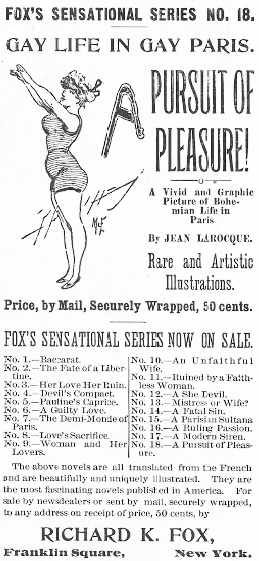
“These works, heretofore carefully concealed from public view, and kept by booksellers only to meet what some consider the legitimate demand of the student, or gentlemen’s library, are now advertised and sold by certain parties as “rich, rare, and racy” books, “amorous adventures,” “spicy descriptions,” “love intrigues on the sly,” etc.”

Nude-Art

Comstock had a similar approach to the visual arts: he did not object to elite society viewing nude paintings in the context of a museum, but when a gallery began selling photographic reproductions of nude paintings to the masses, he shut them down.

In 1873 Comstock and his organization sponsored a set of federal laws—commonly known as the “Comstock Laws”—which made it a federal crime to send “obscene, nude or lascivious” material through the U. S. Mail. This included information about birth control and abortion. Anthony Comstock was appointed a special agent of the Post Office to enforce the laws.

While publications like The National Police Gazette still routinely ran advertisements for racy pictures, abortifacients, and rubber goods (condoms), Comstock claimed to have seized 130,000 pounds of books, 194,000 “bad” pictures, 5,500 indecent playing cards, and 3,150 pills and powders used by abortionists, in the first year alone.

Comstock2

Expanding the campaign to include birth control and abortion set him against a whole new class of notorious opponents. Pretending to be seeking birth control information for his wife, Comstock entrapped Madame Restell, New York’s most infamous abortionist. While out on bail she committed suicide by cutting her throat. He brought legal proceedings against George Bernard Shaw and got the city of New York to ban Margaret Sanger’s work on family planning. When free love advocate, Victoria Woodhull, published a story charging Reverend Henry Ward Beecher with adultery, Comstock had her arrested. Woodhull, who at the time was the presidential candidate for the short-lived Equal Rights Party, had to spend Election Day in jail.

Comstock fought his last battle in San Francisco while attending the International Purity Congress. He initiated prosecution against a San Francisco department store for dressing nude mannequins in the store window in public view. He lost the case and never recovered from the ridicule that it generated.

Though Anthony Comstock died in 1915, his laws lived on. The Comstock Laws were not fully repealed until the 1990s.


Sources:


  • Beisel, Nicola Kay. Imperiled Innocents: Anthony Comstock and family reproduction in Victorian America. Princeton, N.J.: Princeton University Press, 1997.
  • Miller, Neil. Banned in Boston: the Watch and Ward Society's crusade against books, burlesque, and the social evil. Boston: Beacon Press, 2010.
  • Sante, Luc. Low life: lures and snares of old New York. New York: Farrar Straus Giroux, 1991.