


Tag: 1860s
A Lunatics Ball.
Ball of lunatics at the Asylum, Blackwell's Island, East River, N. Y.

The Merry Wives of Boston.
Such is Boston morality and such is woman's fidelity.
Burning of Steamers at Cincinnati.
Burning of Steamers on the Ohio River at Cincinnati May 17, 1869.
A Velocipede Riding-School.
Scene in a velocipede riding-school, New York City.
On The Beach at Newport, Rhode Island.
On the Beach at Newport, Rhode Island.
Great Base Ball Match.
Great baseball match between the Atlantic and Boxford Clubs of Brooklyn.
In Consequence of the New Liquor Law.
In consequence of the new liquor law, this is the ingenious manner in which a worthy teuton friend of ours takes his family out for their Sunday rambles.
An Adventure with a Sea-Lion.
With open mouths and protruding tusks, they warn the intruder agents too near an approach.
Foundering of the Titania.
One of the most thrilling disasters at sea that has happened for many years.
A Magical Duet on the Guitar.
An extraordinary account of a mathematician, mechanician, and musician named Alix.
Thrilling Railroad Accident.
Startling accident at the draw bridge of the Rensselaer and Saratoga Railroad, Federal Street, Troy, N. Y., Saturday, Sept 23.
A Train of Cars Rushing Through Fire.
Traveling through fire—Fearful peril of a railway train, at Cedar Swamp, on the Eastern Railroad, Maine, Sunday, Sept. 17
A Human Rat Eater.
An employee of the Boston Gas Works boasted his ability to kill a rat with his teeth.
December 1860.
Styles for the Month.
The Terrific Leap at Niblo’s Garden, From an Aerial Apparatus.
The original and daring aerial representation by Thomas Hanlon, now performed by him every evening at Niblo's Garden.
Mdlle. Carlotta de Berg.
Mdlle. Carlotta de Berg, at the New York Circus, Fourteenth Street.
Surf Swimming at Hawaii, Sandwich Islands.
Faahee, or surf-swimming, is a favorite pastime with the natives of the Sandwich Islands.
The White Porpoise.
We give in our present number a correct sketch of one of the largest specimens of the Porpoise that has ever been seen.
Murderous Assault by a Wife on Her Husband.
An Undertaker’s Assistant’s Mistake.
Uncle Sam's Thanksgiving Dinner.
Burglary Tools.
The Advent of Spiritualism.
A simple schoolgirl prank spawned a new belief with millions of followers.
Copper.
A Slippery and Subtle Knave – The Bank Sneak.
Kate Warne.
Kate Warne, America’s first female detective.
Melancholy Boat Accident.
Allan Pinkerton.
The Eye that Never Sleeps.
The Cardiff Giant
Cardiff, New York, October 16, 1869.
Strange Company - 8/7/2026
Early American Crime - 2/7/2019

Soapy Smith's Soap Box - 10/13/2025
Murder By Gaslight - 8/1/2026
Executed Today - 11/13/2020

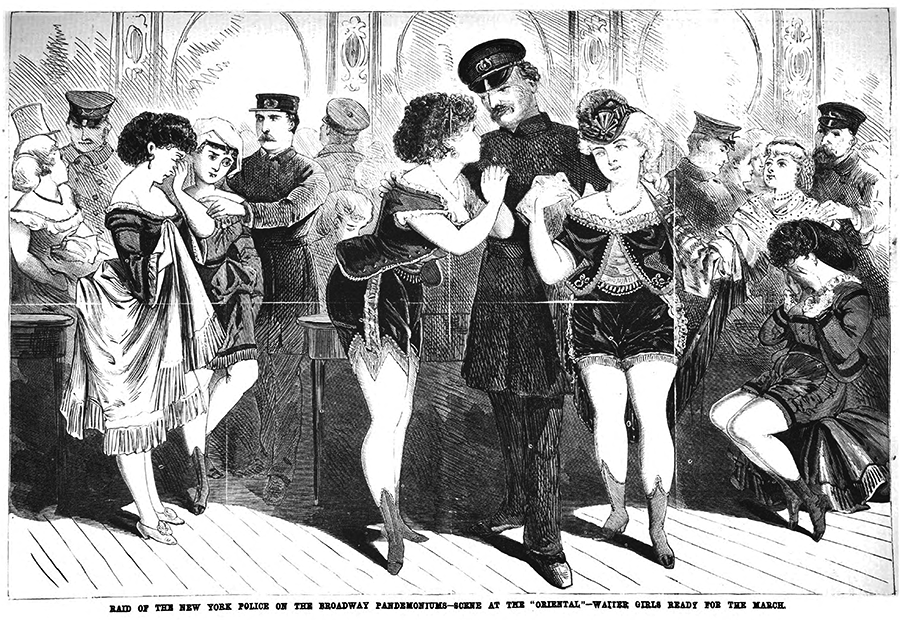
Demi-Monde Excursion. | A Rattling Main.
Pandemonium in a Tumult.
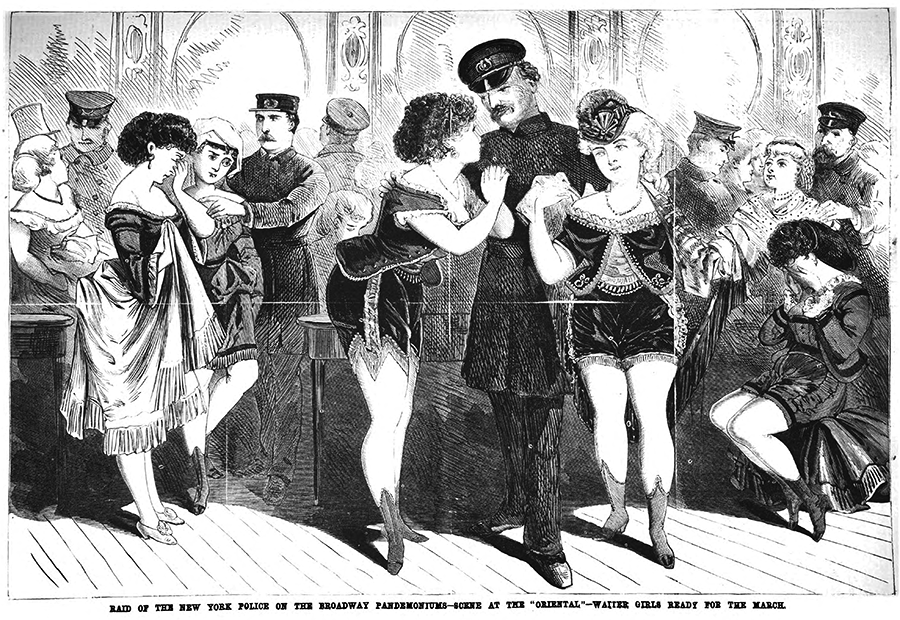
If there is in New York one spot more infamous than another, that spot is the section of Broadway on the east aide, between Bleecker and Houston streets. Hell gapes widely here for all who may pass after 7 o'clock in the evening. From Bleecker to Spring street there are at least three hundred abandoned females employed in those dens of infamy known to the public as concert saloons. During the last twelve months, this evil has grown to almost gigantic proportions, yet nothing was done to abate it until the evening of the 22d inst., when sixty-eight concert saloon waiter girls were arrested, together with three or four of the managers and proprietors of the dens.
Illustrated Police News, February 1, 1872.
Welcome to the National Night Stick
"We follow vice and folly where a police officer dare not show his head, as the small, but intrepid weasel pursues vermin in paths which the licensed cat or dog cannot enter."The Sunday Flash 1841

- 1810s
- 1820s
- 1830s
- 1840s
- 1850s
- 1860s
- 1870s
- 1880
- 1880s
- 1890
- 1890s
- Abduction
- Abortion
- Accident
- Actors
- Adultery
- Advertisement
- African Americans
- Alabama
- Alcohol
- Allan Pinkerton
- America
- Animal
- Assault
- Axe Murder
- Bank Robbery
- Barnum
- Baseball
- Beer
- Bet
- Bicycle
- Billiards
- Bio
- Boston
- Boxing
- Boys
- Broadway
- Brooklyn
- Brothel
- Buffalo
- Burglar
- Burglary
- Burlesque
- California
- Canada
- Cartoon
- Censorship
- Chicago
- children
- Chorus Girls
- Christmas
- Cincinnati
- Civil War
- Clergy
- Clubbing
- College
- Colorado
- Comstock
- Con Game
- Connecticut
- Counterfeit
- Court
- Cowboy
- Crime
- cross-dressing
- Crossdressing
- Cursing
- Dancing
- Deception
- Delinquents
- Denver
- Detectives
- Detroit
- Dime Novels
- Disaster
- Disguise
- Disorderly conduct
- Divorce
- Domestic Violence
- Drowning
- Duel
- Editorial
- Election
- Entertainment
- Event
- Fad
- Family
- Fashion
- Fight
- Fire
- Food
- Football
- Forger
- Fraud
- Gambling
- Gangs
- Georgia
- Great Detectives
- Gunshot
- Hoax
- Holiday
- Horses
- Hotel
- Illinois
- Indiana
- Insanity
- Jail Break
- Jealousy
- Justice
- Kansas
- Kentucky
- Little Murders
- Louisiana
- Lynching
- Maine
- Marriage
- Maryland
- Massachusetts
- Medicine
- Michigan
- Minnesota
- Missouri
- Montana
- Murder
- Music
- Nevada
- New Hampshire
- New Jersey
- New Orleans
- New Year
- New York
- New York City
- Newsboys
- Newspaper
- Nudity
- Obscenity
- Ohio
- Opium
- Pennsylvania
- Performer
- Petrified man
- Photography
- Pickpocket
- Poisoning
- Police
- Police Gazette
- Politics
- Prank
- Prison
- Prostitution
- Railroad
- Rape
- Rats
- Reform
- Religion
- Reporters
- Revenge
- Rhode Island
- Robbery
- Romance
- Saloon
- San Francisco
- Scandal
- Science
- Seasonal
- Sex
- Slashing
- Society
- Spiritualism
- Sport
- Sports
- Spousal Abuse
- St. Louis
- Stabbing
- Steamboat
- Steamship
- Stock Broker
- Suicide
- Summer
- Tammany Hall
- Temperance
- Tennessee
- Texas
- Theatre
- Theft
- Thomas Byrnes
- Valentine
- Vigilantes
- Voyeur
- War
- Washington D.C.
- Wife beaters
- Winter
- Women