
No. 480
Crime, Eccentricity, and the Sporting Life in 19th Century America.
July 30, 2019

Gold from Seawater!

In 1898, the Reverend Prescott F. Jernegan founded the Electrolytic Marine Salts Company to extract gold from seawater. When the gold ran out, so did Rev. Jernegan, taking the company’s capital.
July 30, 2019
...
...

Tag: Photography

A New Child Abandonment Trick.

How a woman slipped out and left a kid on a photographer's hands.

11/4/2024

The Craze of the Day.

The amateur camera fiend carries his deadly machine in all sorts of disguises, nowadays.

3/6/2017

Amateur Photography.

The only way to prove that you have been clubbed by a policeman - photograph him in the act.

4/6/2015

Photographed as he Died.

6/24/2014

Society Unveiled.

2/3/2014
Via Newspapers.comSome people could be said to create an “electric atmosphere.”This is not always a good thing.  The “Wells Journal,” December 9, 1993:A physicist claimed this week to have come up with evidence which completely exonerates pensioner Frank Pattemore for any involvement in the weird goings on with the electrical system at his home. For more than 11 years, Mr Pattemore's
More...
Strange Company - 4/1/2026
"As his son I am proud of hisefforts to succeed in life"Jefferson Randolph Smith IIIArtifact #93-2Jeff Smith collection(Click image to enlarge) oapy's son hires a legal firm to stop the defamation of his father's name. At age 30, Jefferson Randolph Smith III, Soapy and Mary's oldest son, was protecting his father's legacy and his mother's reputation from "libel" and scandal. He was also
More...
Soapy Smith's Soap Box - 10/13/2025
New York didn’t invent April Fools Day; this holiday might date back all the way to ancient Rome. But starting in the 19th century, April 1 in Gotham has been a day to celebrate with stupid pranks, outrageous hoaxes, the mocking of politicians and business leaders, and since 1986, a parade down Fifth Avenue. This […]
More...
Ephemeral New York - 3/30/2026
Youth With Executioner by Nuremberg native Albrecht Dürer … although it’s dated to 1493, which was during a period of several years when Dürer worked abroad. November 13 [1617]. Burnt alive here a miller of Manberna, who however was lately … Continue reading
More...
Executed Today - 11/13/2020
National Police Gazette, January 28, 1882Mrs. J.W. Gibbons was away from her home in Ashland, Kentucky, on December 23, 1881. She left behind her 18-year-old son Robert, her 14-year-old daughter Fannie, and 17-year-old Emma Thomas (aka Carico), who was staying with them. Mrs. Gibbons returned the following day to find her home burned to the ground and all three inhabitants dead.Read the full
More...
Murder By Gaslight - 3/28/2026
Whatever you believe about the guilt or innocence of Lizzie Borden, I have always believed film makers do a great injustice to the story by not beginning at the beginning- the death on March 26, 1863 of the first Mrs. Borden. In the dying moments of Sarah Morse, Emma takes on the weight of the care of her little sister, not yet three years old. Emma herself was just 12 on March 1st. Emma has seen her mother suffer for a long time, seen her pain and loss of little Alice Esther. Emma is old enough
More...
Lizzie Borden: Warps and Wefts - 3/26/2026
  [Editor’s note: Guest writer, Peter Dickson, lives in West Sussex, England and has been working with microfilm copies of The Duncan Campbell Papers from the State Library of NSW, Sydney, Australia. The following are some of his analyses of what he has discovered from reading these papers. Dickson has contributed many transcriptions to the Jamaica […]
More...
Early American Crime - 2/7/2019

Baseball Animals. | Kate Warne.

Gold from Seawater!

Gold from Seawater

In a shack on a pier in Providence, Rhode Island, one chilly February afternoon in 1897, the Reverend Prescott F. Jernegan gave a scientific demonstration to Anthony F. Pierson and Arthur B. Ryan, two prominent Connecticut businessmen. At Jernegan’s request, the men had brought with them a zinc lined box built to Jernegan’s specification and several jars of mercury. Reverend Jernegan insisted that the men bring their own equipment so there would be no question as to the authenticity of the experiment. This was hardly necessary as Ryan knew the Baptist minister well and could vouch for his honesty.

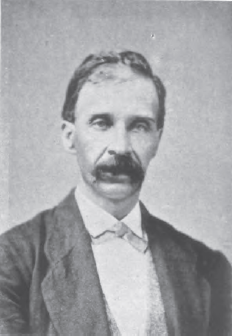
The Reverend Prescott F. JerneganThe Reverend Prescott F. Jernegan.

The experiment would demonstrate the discovery by Reverend Jernegan of a method of extracting gold from seawater. It was well known that seawater contained a measurable amount of gold but there was no profitable way to extract it. Jernegan would remedy that. He poured the mercury into a pan in the bottom of the box, sprinkled some of his secret formula over it, attached electrodes from the pan to a battery, covered the box with a lid, perforated to let the water in and out, then he lowered the box through a trapdoor into the ocean below. The men then settled in to wait for morning, no doubt spending the night discussing the fortunes to be made if the experiment proved true.

At dawn Jernegan opened the trapdoor and pulled up the box. When he opened the box the men could see that some of the mercury was gone. The Connecticut men took away what was left and had it analyzed by a chemist. Sure enough, the chemist found traces of copper and silver along with $4.50 worth of gold. The experiment was a success, Jenegan had succeeded in extracting gold from seawater.

The demonstration was repeated at several other locations in Rhode Island and Connecticut generating considerable interest among potential investors. On November 5, 1897 five of them met with Reverend Jernegan and his partner Charles Fisher in Portland, Maine to form the Electrolytic Marine Salts Company. They issued ten million shares of stock at a par value of $1.00 per share and began selling them to raise capital for the new company.

The company purchased a grist mill in North Lubec, Maine, and there built a plant over the ocean where they sunk 243 “gold accumulators.” They named it the Klondike Plant and by July 1898 it was pulling in gold at the rate of $308 dollars a day. Work had already begun on Klondike Plant No. 2.

Charles FisherCharles Fisher.

Unbeknownst to any of the investors, the gold that manifested in the accumulators was actually placed there at night by Charles Fisher who opened them up underwater while wearing a diving suit with a tank of compressed air. He would remove some of the mercury and replace it with mercury he had laced with gold. All of the experiments were done this way and he even salted the accumulators at the Klondike Plant. He and Jernegan had used the early investments to buy old jewelry which they melted down and added to the mercury.

Charles Fisher and Prescott Jernegan, both sons of whaling captains, had grown up together in Edgartown, Martha’s Vineyard before Jernegan got the calling. Years later they reunited and came up with a scheme that they believed, correctly, would be worth a fortune. They practiced together until they could pull off the experiments without a hitch and they were even able to convincingly run the Klondike Plant for a time.

Then one day in July 1898 the plant stopped paying. No gold came up in the accumulators. The investors learned that a large sum of money had been withdrawn from the accounts of the Electrolytic Marine Salts Company, and Jernegan and Fisher were nowhere to be found. Fisher had fled to New South Wales. Jernegan, under the alias Louis Sinclair, had taken his wife and family, along with about $100,000 to Europe. He sent a letter to Ryan saying Fisher had run off with the secret formula and he had gone to track him down.

A while later Jernegan had a change of heart. Maybe it was his religious training coming back or maybe he just enjoyed perpetrating the fraud more than the spoils, but he sent a check for $75,000 from Brussels, Belgium to his investors in the United States. That, together with the sale of the property allowed investors to recover thirty-six cents for every dollar invested. Jernigan tried the scheme again in England, but the Brits proved harder to fool and he lost $30,000.

Prescott Jernegan surfaced again around 1901 in the Philippine Islands. He had gone straight, becoming a schoolteacher there and publishing several books on Philippine history and culture.


Sources: