
No. 127
Crime, Eccentricity, and the Sporting Life in 19th Century America.
January 08, 2013

The Sympsychograph.

January 8, 2013
...
...

 Welcome to this week's Link Dump!While you read, feel free to visit our open bar.Watch out for those hypnotic serpents!The murder of the Coy family.A brief history of soap.Cats may wind up curing cancer, which wouldn't surprise me a bit.When you're a spiritualist, you don't care if your fiance is dead.The scientific debate over free will.The pyramids of Mars.A surprisingly modern ancient
More...
Strange Company - 3/20/2026
"As his son I am proud of hisefforts to succeed in life"Jefferson Randolph Smith IIIArtifact #93-2Jeff Smith collection(Click image to enlarge) oapy's son hires a legal firm to stop the defamation of his father's name. At age 30, Jefferson Randolph Smith III, Soapy and Mary's oldest son, was protecting his father's legacy and his mother's reputation from "libel" and scandal. He was also
More...
Soapy Smith's Soap Box - 10/13/2025
Bond Street today is a pricey place to live. And so it was in the 1830s, when it became one of New York’s most exclusive enclaves. Wealthy residents fleeing the crowded and increasingly commercial neighborhoods below Houston Street sought refuge on this short little street, which only runs two blocks from Broadway to the Bowery. […]
More...
Ephemeral New York - 3/16/2026
Youth With Executioner by Nuremberg native Albrecht Dürer … although it’s dated to 1493, which was during a period of several years when Dürer worked abroad. November 13 [1617]. Burnt alive here a miller of Manberna, who however was lately … Continue reading
More...
Executed Today - 11/13/2020
About half past three, the morning of July 2, 1863, a young man on his way to work in Medina, Ohio, saw the home of Shubal Coy in flames. He alerted the neighbors, who came out to douse the flames with water. When the fire was under control, they went inside to look for the Coy family. They found Shubal lying in bed with nine stab wounds in his throat and breast, any one of them capable of
More...
Murder By Gaslight - 3/14/2026
The good-looking thirty-seven year old gentleman handling the reins behind the glossy matched pair pulling the spanking-new carriage drew the attention of more than one feminine eye.  Pacing down French St. at a sharp clip, the lady next to him, dressed neatly in a tailor-made suit with the latest in millinery fashion, smiled up at her coachman. Behind the lace curtains on the Hill section of Fall River, tongues were wagging about the unseemly pair. Lizzie Borden, acquitted of double homici
More...
Lizzie Borden: Warps and Wefts - 10/16/2025
  [Editor’s note: Guest writer, Peter Dickson, lives in West Sussex, England and has been working with microfilm copies of The Duncan Campbell Papers from the State Library of NSW, Sydney, Australia. The following are some of his analyses of what he has discovered from reading these papers. Dickson has contributed many transcriptions to the Jamaica […]
More...
Early American Crime - 2/7/2019

Vive Le Sport! | Happy New Year!

The Sympsychograph.

Sympsychograph

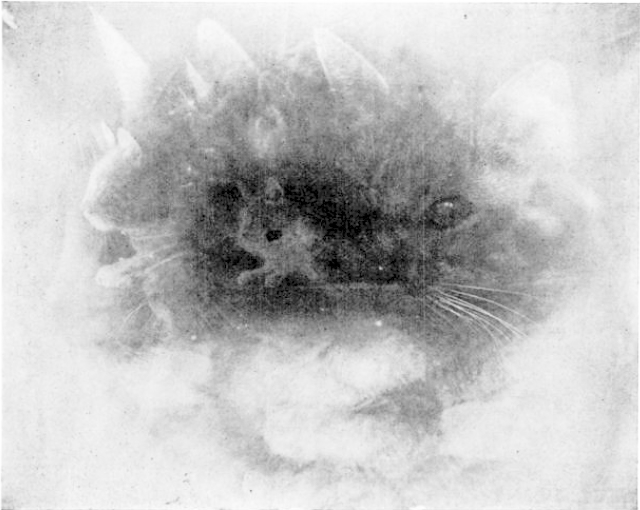
In September 1906, Popular Science Monthly published this picture—a psychic photograph generated by seven men thinking about a cat. It was such an obvious hoax that the editors thought their readers would catch on right away. They didn’t.

The article by David Starr Jordan, entitled “The Sympsychograph: A Study in Impressionist Physics” documents an experiment by the Astral Camera Club of Alcalde to create a photograph using “brain emanations, or odic forces.” The club, having learned of Prof. Rontgen’s work with x-rays, was anxious to try experiments in photography without visible light. Allegedly, an Englishman named Camreon Lee had captured a photographic image of a thought by staring into the lens of a camera in total darkness and intensely thinking of a cat. When the negative was developed it showed the enlarged pupil of the eye and in it center, the faint image of a cat.

Asa Marvin, president of the Astral Camera Club devised an elaborate experiment. He created a lens with curved facets, similar to a fly’s eye. To each of the seven facets led an insulated tube containing an electric connection to transfer impulses from the brain of each observer and converge on a photographic plate.

Seven members of the club, “having the greatest animal magnetism and greatest power of mental concentration,” were chosen for the experiment. Connections were made from the eye of each observer to the corresponding parts of the lens, then in total darkness each man would think of a cat. They were not to think of any particular cat, but rather of the innate idea of a cat. The goal was to bring out the impression of ultimate feline reality. The seven ideals would be sympathetically combined and the true cat would be developed – sympsychography. The picture above was the purported result of the experiment.

The photograph was actually a composite made from several negatives of the same cat. Jordan peppered the article with scientific-sounding terminology as he explained, in detail, the methodology employed and analyses the result. But he also included several cues to inform scientific-minded readers that this is a bit of satire: the green light of their apparatus “provoked that uncanny feeling that always presages a great discovery in occult science;” the next step would be to photograph “the cat’s idea of a man;” and, of course, the experiment was performed on April 1.

But Jordan had underestimated the gullibility of his readers. He and the editors of Popular Science Monthly were amazed at the number of people who took the article seriously. Many welcomed the alleged discovery as proof of long held beliefs. One clergyman had even announced a series of six discourses on “The Lessons of the Sympsychograph.”

Jordan concluded that few people ever read a sensational story to the end and scarcely read beyond pictures and headlines. Though he vowed never again to try to be funny, he did document further proceedings of The Astral Club of Alcalde in “The Posthom Phantom: A study in the Spontaneous Activity of Shadows;” “The Teaching of Neminism,” an exposition of the thesis hihil nemini nocet, or “nothing hurts nobody;” “The Plane of Ether,” a theosophical analysis of the way to Nirvana; and “Rescue Work in History,” a contribution to the theory that time and space are relative.