
No. 642
Crime, Eccentricity, and the Sporting Life in 19th Century America.
July 26, 2022

A Hot Day in New York.
While New York is by no means the hottest city in the country, there have been a few days during the present season when the temperature reached a height altogether incompatible with human comfort.
July 26, 2022

...
...

Tag: Sleepwalking

A Sleep-Walker’s Act.

Miss Belle Collis, of Newark, N. J., surprises the neighbors by her want of thought.

3/26/2016
 Welcome to this week's Link Dump!And you're just in time for afternoon tea!A flying horse in Staffordshire.A mysterious murder-suicide.New York's war against banana peels.The houseplant that can count.Fun and games in medieval London.Hitler's dress rehearsal for war.A coded letter from Napoleon has finally been deciphered.A woman is cleared of being a witch.  Three hundred years after
More...
Strange Company - 10/9/2026
  [Editor’s note: Guest writer, Peter Dickson, lives in West Sussex, England and has been working with microfilm copies of The Duncan Campbell Papers from the State Library of NSW, Sydney, Australia. The following are some of his analyses of what he has discovered from reading these papers. Dickson has contributed many transcriptions to the Jamaica […]
More...
Early American Crime - 2/7/2019

"As his son I am proud of hisefforts to succeed in life"Jefferson Randolph Smith IIIArtifact #93-2Jeff Smith collection(Click image to enlarge) oapy's son hires a legal firm to stop the defamation of his father's name. At age 30, Jefferson Randolph Smith III, Soapy and Mary's oldest son, was protecting his father's legacy and his mother's reputation from "libel" and scandal. He was also
More...
Soapy Smith's Soap Box - 10/13/2025

 Laura D. Fair and Alexander P. CrittendenA prominent California legislator was sitting with his wife and son on board the Oakland-San Francisco ferryboat El Capitain the evening of November 3, 1870. They did not notice the woman approaching them, dressed entirely in black, wearing a broad-brimmed black hat with a black veil covering her face. From the folds of her dress, the woman
More...
Murder By Gaslight - 10/10/2026

Youth With Executioner by Nuremberg native Albrecht Dürer … although it’s dated to 1493, which was during a period of several years when Dürer worked abroad. November 13 [1617]. Burnt alive here a miller of Manberna, who however was lately … Continue reading →
More...
Executed Today - 11/13/2020
A Transparent Rigg. | Caught a Cowboy.

A Hot Day in New York.

Jaws of the Man-Eaters

In the Jaw of the Man-Eaters.

James E. Hamilton of Lake Worth, Florida, is Devoured by Sharks. [more]

Terrific But Vain Fight of a Mail Carrier With Man-Eaters.

A special form Jacksonville, Fla. Oct 20, says: The dread of the mail carriers on the Florida southeast coast are the Hillsboro and New River inlets, which have to be crossed by small boats. Here the dark waters of the Everglades empty into the Atlantic with tremendous force at this season, and if the ocean is rough the meeting of the cross currents produces heavy and dangerous seas. Sharks of the fiercest kind fill the inlets.

James E. Hamilton, the mail carrier from Miami to Lake Worth, was an athletic young man and carried the light mail on his shoulders, waking the entire distance. Seventy-five miles, on the beach. He left Lake Worth on Tuesday, in the morning, and should have reached the Refuge Station, twenty-five miles distant, that afternoon.

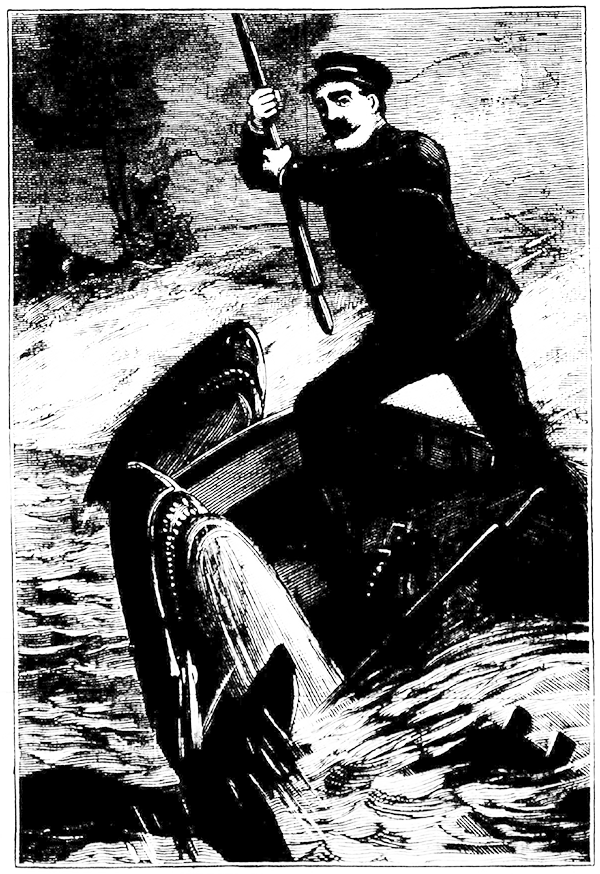
Late at night a fisherman named Waring came to the station and told the story of Hamilton’s horrible death. Waring was about one-half mile from Hillsboro Inlet when he saw Hamilton get into his boat to cross. He noted that the sharks were about in unusual numbers, and just as Hamilton reached the center of the crossing a huge one drove at the boat and bit a piece off the gunwale.

Hamilton struck at the sharks, but nothing could drive them off. Soon both oars were bitten in two, and then the fierce tigers of the sea seemed perfectly ravenous. The tore at the boat, snapped at one another, and the water for yards around was dyed with their blood. The boat began to fill, and the sharks scenting their prey, redoubled their dashes.

Hamilton stood on the middle seat as if stupefied glaring at them. Looking up and seeing Waring, he cried out to him, but in vain. Even as he shouted a huge monster dashed up and hit the partially filled boat a tremendous blow, throwing Hamilton out into the midst of the monsters.

A cry of agony was heard as he went down, and the devourers had him piecemeal before the horror-stricken spectator could take in the full measure of the tragedy. As soon as Waring recovered his senses he went to the station and told of the affair. A searching party went out at once but nothing was found save the remnants of the boat cast on the shore.


Reprinted from National Police Gazette, November 19,1887.

Hot day in New York

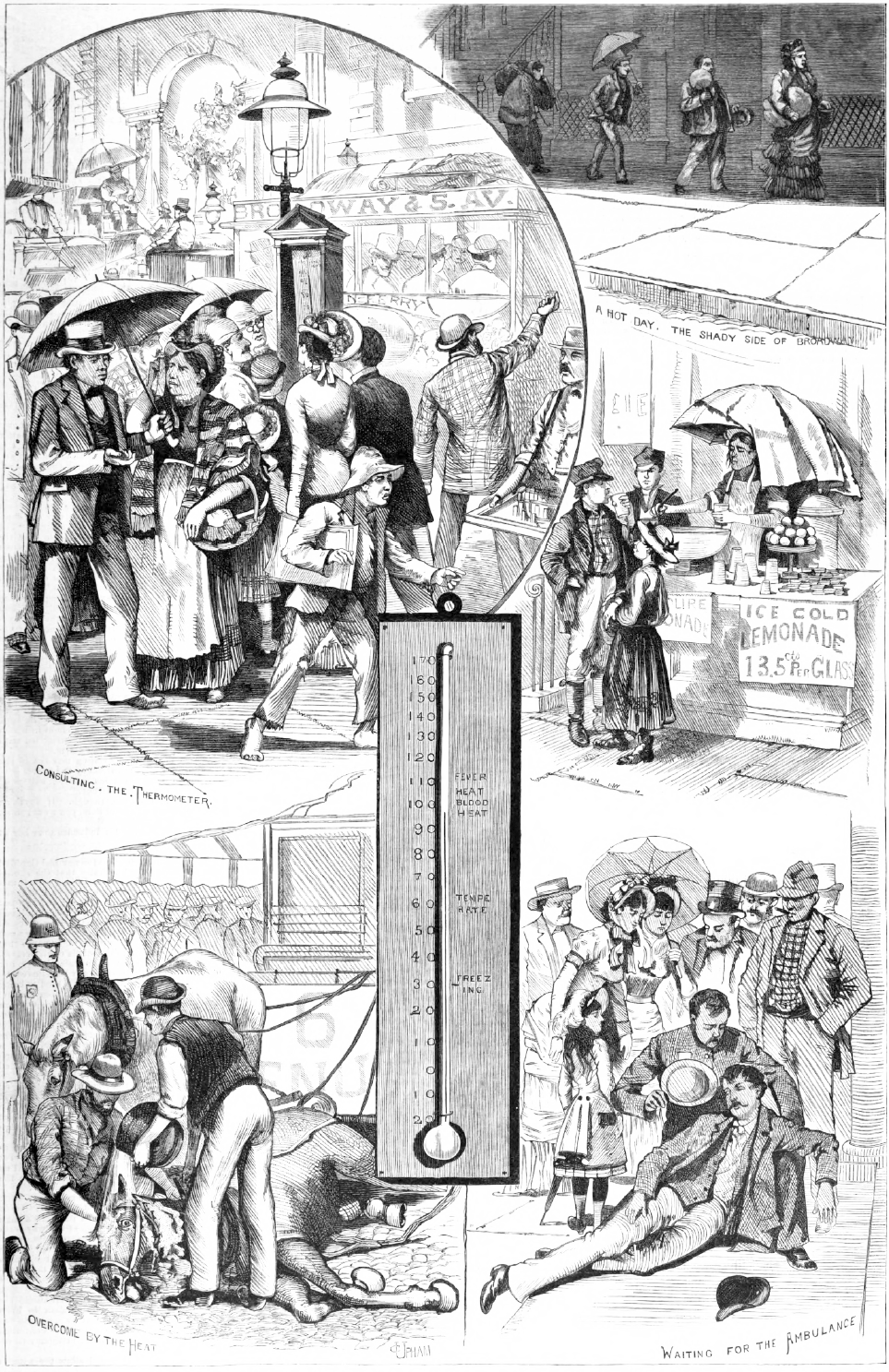
While New York is by no means the hottest city in the country, there have been a few days during the present season when the temperature reached a height altogether incompatible with human comfort. There were two such days last week, when the temperature reached ninety-four degrees in the shade, and the sufferings of those exposed to the torrid rays of the sun were intense. On the 23d, especially the heat was most oppressive and man and beast alike succumbed to its influences. The air was moist, no breeze was stirring, and when the noonday sun looked down upon Broadway it saw not one but many thousands of wilted men and women. Among the tenement houses the suffering was great, perhaps than at any time during the summer. The streets were deserted in the middle of the day, and the sweltering thousands labored and drudged in their hot and dismal rooms with no chance of relief. In the evening they swarmed about doorsteps and hallways and filled the streets.

Our illustration strikingly depicts the incidents of one of these hot days—the feverish consultation of the thermometer, the eager quest for comfort on the shady side of the street, the prostration of man and beast by the pitiless heat. Happy are they who in such “torrid times” as these are able to find cool retreats on mountain tops or by the sea or in fragrant forest depths where no ray of sun can ever penetrate.


Reprinted from the National Police Gazette, September 1, 1883