Cardiff, New York, October 16, 1869 – Workers digging a well behind the barn on the farm of William C. “Stub” Newell unearthed a ten foot four inch stone giant. Word spread quickly and people came by the thousands to view the behemoth and speculate as to its origin. Some said it was a petrified man, citing Genesis 6:4, “There were giants in the earth in those days.” Others believed it was a statue created by earlier inhabitants of New York. The attraction was so strong that even when the stone colossus was revealed to be a hoax people stood in line and paid fifty cents each to view the Cardiff Giant.
The Cardiff Giant was the brainchild of George Hull, a tobacconist from Binghamton, New York. During a visit to his sister in Iowa, he got into a heated argument over the truth of Bible stories. Specifically, he could not understand the belief in Biblical giants and wondered if he could create a stone man and pass it off as a petrified giant. He became so obsessed with the idea that he sold his business and went looking for stone.
He found what he wanted near Port Dodge in Iowa—gray gypsum with bluish streaks that would pass for human veins. Hull bought an acre of land with an outcropping of this stone and hired a force of men to chop out a block 11’ 4” x 3’ 6” x 2’. After an arduous journey by wagon to Boone, Iowa then by train to Chicago, the stone block was handed over to an Italian stonecutter named Salla, who, after being sworn to secrecy, carved the giant man.

Salla took the work very seriously, cutting away some spots as if the flesh were imperfectly petrified, and using a tool made from a bundle of darning needles over the entire surface to simulate pores in the giant’s skin. When it was done, he poured sulphuric acid over the sculpture to give it the appearance of antiquity. It was packed in an iron box and sent to Union, New York. The entire package weighed 4000 pounds.
Hull chose Cardiff as the burial site because it has an ancient lake bed where fossilized fish and reptiles had been found. He took “Stub” Newell into his confidence and the two men, working late at night buried the giant on Newell’s farm. Hull then went back to cigar making for one year less two weeks before giving Newell instruction to “discover” the giant.

While Hull was still in the shadows, Newell began charging fifty cents a head to view the Cardiff Giant, now enclosed in a tent behind the barn. He had made at least $7000 before Hull returned to the scene.
The State Geologist and a number of other scientists declared that it was, indeed, a petrified man. John F. Boynton, an early Mormon leader believed it was not a man but a statue carved by French Jesuits in the 16th century to impress the Indians. Among those taken in by the Cardiff Giant and expressing belief in its authenticity were Oliver Wendell Holmes and Ralph Waldo Emerson.
Newell began receiving offers to buy the giant. Seeing that Newell could not be trusted to keep the secret—he had already told several relatives and friends—Hull told him to sell. Newell sold three-fourths interest to Higgins, Gillett & Westcott in Syracuse for $30,000, of which Hull received $20,000 and one-quarter interest. He eventually sold the last quarter and the new owners moved the giant to Syracuse.

In Syracuse, the giant received closer scrutiny and Yale paleontologist Othniel C. Marsh declared the Cardiff Giant a clumsy fake. There were fresh chisel marks that would have worn away if the giant had been in the ground any length of time. Having already cashed out, Hull came clean and revealed the giant’s true history. The public didn’t seem to care; they nicknamed the attraction “Old Hoaxey” and continued paying to view it.

At one point showman, P. T. Barnum offered the new owners $60,000 to use the giant for three months. When they refused, Barnum had a German sculptor make him his own Cardiff Giant. The owners tried to sue Barnum, but the judge refused to hear the case because the owners could not prove that their giant was genuine. Soon after there were at least six copies of the Cardiff Giant being exhibited throughout the country.
The Cardiff Giant also inspired a wave of imitators:
The original Cardiff Giant was displayed at the Pan American Exposition in Buffalo, New York, in 1901. It was then purchased by an Iowa publisher for his basement rumpus room. In 1947 he sold it to the Farmers’ Museum in Cooperstown, New York where it is on display today. Barnum’s “fake” Cardiff Giant is on display at Marvin’s Marvelous Mechanical Museum in Farmington Hills, Michigan.

Sources:
The Night the Cardiff Giant Sang Rossini on the Lawn

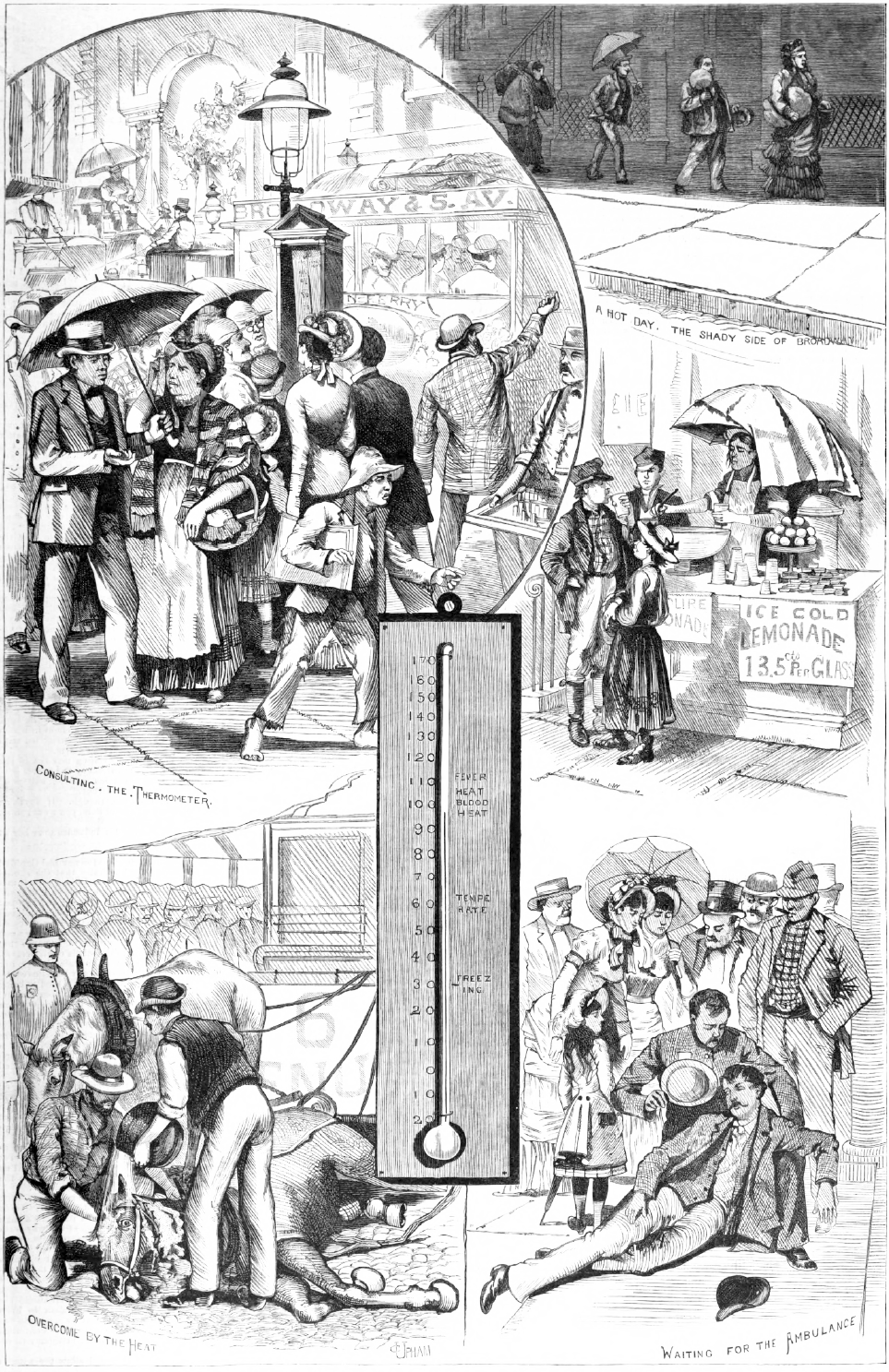
While New York is by no means the hottest city in the country, there have been a few days during the present season when the temperature reached a height altogether incompatible with human comfort. There were two such days last week, when the temperature reached ninety-four degrees in the shade, and the sufferings of those exposed to the torrid rays of the sun were intense. On the 23d, especially the heat was most oppressive and man and beast alike succumbed to its influences. The air was moist, no breeze was stirring, and when the noonday sun looked down upon Broadway it saw not one but many thousands of wilted men and women. Among the tenement houses the suffering was great, perhaps than at any time during the summer. The streets were deserted in the middle of the day, and the sweltering thousands labored and drudged in their hot and dismal rooms with no chance of relief. In the evening they swarmed about doorsteps and hallways and filled the streets.
Our illustration strikingly depicts the incidents of one of these hot days—the feverish consultation of the thermometer, the eager quest for comfort on the shady side of the street, the prostration of man and beast by the pitiless heat. Happy are they who in such “torrid times” as these are able to find cool retreats on mountain tops or by the sea or in fragrant forest depths where no ray of sun can ever penetrate.
Reprinted from the National Police Gazette, September 1, 1883