
No. 503
Crime, Eccentricity, and the Sporting Life in 19th Century America.
January 07, 2020

A Slippery and Subtle Knave – The Bank Sneak.

Of the many forms of bank robbery, the bank sneak had the safest, easiest and most lucrative method of all.
January 7, 2020
...
...

Tag: Montana

He May Be Lynched.

Miss Lily Dunkley, a Miles City, Mont., girl, refuses to marry Charles Snyder and he tries to kill her.

3/30/2015

He May Be Lynched.

Miss Lily Dunkley, a Miles City, Mont., girl, refuses to marry Charles Snyder and he tries to kill her.

3/10/2015

He Hit the Pipe

A Minneapolis millionaire, visits an opium joint and is carried out feet first.

11/20/2011
 It's time for this week's Link Dump!Let's dance!That time when an English village was terrorized by a giant rabbit.How the Declaration of Independence made the news.The socialite and the "Titanic orphans."The last victim of the Berlin Wall.Remembering the American Soapbox.Life on one of Lord Nelson's 32-pounders.The hidden communication of animals.British fairies, meet Indian changelings.3I
More...
Strange Company - 4/17/2026
"As his son I am proud of hisefforts to succeed in life"Jefferson Randolph Smith IIIArtifact #93-2Jeff Smith collection(Click image to enlarge) oapy's son hires a legal firm to stop the defamation of his father's name. At age 30, Jefferson Randolph Smith III, Soapy and Mary's oldest son, was protecting his father's legacy and his mother's reputation from "libel" and scandal. He was also
More...
Soapy Smith's Soap Box - 10/13/2025
Riverside Drive is one of Manhattan’s most beautiful and dramatic avenues. It’s also a place of legend and mystery, especially during the Drive’s early decades as a Gilded Age “millionaire colony” rival to Fifth Avenue. Which mansion built in the early 1900s has a basement tunnel leading to the Hudson River? Where can you find […]
More...
Ephemeral New York - 4/16/2026
Youth With Executioner by Nuremberg native Albrecht Dürer … although it’s dated to 1493, which was during a period of several years when Dürer worked abroad. November 13 [1617]. Burnt alive here a miller of Manberna, who however was lately … Continue reading
More...
Executed Today - 11/13/2020
(New York Journal, May 31, 1896.)On the morning of Memorial Day, May 30, 1896, Mrs. Annie Cunningham had to go to work, while her 13-year-old daughter, Mary (known as Mamie), was home from school for the holiday. Mrs. Cunningham asked Mamie if she planned to go to the parade. Mamie said no, she wasn’t interested, and she planned to do housework and study. At 8:30, she said goodbye to her daughter
More...
Murder By Gaslight - 4/18/2026
Whatever you believe about the guilt or innocence of Lizzie Borden, I have always believed film makers do a great injustice to the story by not beginning at the beginning- the death on March 26, 1863 of the first Mrs. Borden. In the dying moments of Sarah Morse, Emma takes on the weight of the care of her little sister, not yet three years old. Emma herself was just 12 on March 1st. Emma has seen her mother suffer for a long time, seen her pain and loss of little Alice Esther. Emma is old enough
More...
Lizzie Borden: Warps and Wefts - 3/26/2026
  [Editor’s note: Guest writer, Peter Dickson, lives in West Sussex, England and has been working with microfilm copies of The Duncan Campbell Papers from the State Library of NSW, Sydney, Australia. The following are some of his analyses of what he has discovered from reading these papers. Dickson has contributed many transcriptions to the Jamaica […]
More...
Early American Crime - 2/7/2019
"Ten Minutes for Refreshments and Divorce!" | Happy New Year!

A Slippery and Subtle Knave – The Bank Sneak.

Bank Sneak Of the many forms of bank robbery, the bank sneak had the safest, easiest and most lucrative method of all.  Holdup men risked their lives and the lives of others by demanding money at the point of a gun. Bank burglars worked in large gangs, with elaborate plans that always involved the physical labor of cutting, pounding, prying or blasting to get though iron bars and steal vaults. But a skilled bank sneak just walked into a bank, took what he wanted and left.

Part confidence man, part shoplifter, the bank sneak would enter a bank as if he were a regular customer, look for an opportunity, and walk out with a stack of currency or bonds. They would usually work in pairs or groups of three. One or two would divert the attention of clerks and bank officers, while another would quickly snatch the goods and leave. It was not unusual for a bank sneak to leave with $10,000 more.

Bank sneaks were always well dressed. In the city, they appeared to be prosperous businessmen, in the country gentlemen farmers—the type of customer always welcome in a bank. When not in the bank they would frequent men’s clubs and hotel lobbies to learn what they could from real businessmen about bank policies and special interests of bank officers. When a sneak learned the hobby of a particular bank officer, he would study that topic then at the bank, engage the officer in conversation while a confederate grabbed the cash.

Extra Walter Sheridan

Sometimes they traveled with circuses. When the circus came to town and paraded down Main Street, sneaks would hit the banks and take what they could while all eyes were on the circus parade. Another ploy used was the “invalid customer.” A servant would come into a bank, ask for a bank officer by name, and say his master is an invalid in a carriage outside. He wants to discuss an investment but is unable to come into the bank. This was usually done during lunch hour when the bank is already understaffed. When the officer invariably leaves to talk to the invalid, the sneak makes off with the money.

Bank customers were targets as well. A trick known as the “drop game” involved secretly dropping a bill near a counter where a customer is counting his money. The sneak tells the customer that he dropped a bill, and while the customer bends over to pick it up the sneak takes a portion of the customer’s stack of bills.

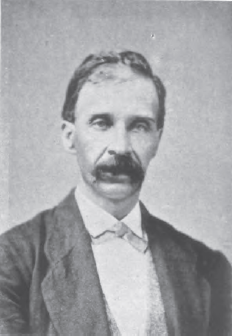
Extra Horace Hovan

Bank sneaks always carried a large amount of money and when they were caught they could easily pay their bail and leave. It was just the cost of doing business. They were also very mobile. Two notable bank sneaks in the 1880s, Horace Hovan and Walter Sheridan were arrested in Toronto, Canada, and easily posted bail. Less than a month later they robbed a bank in Denver, Colorado. Sheridan was identified but escaped; Hovan was caught red-handed coming out of the bank vault with the loot. He very nearly talked himself out of an arrest, but ultimately Hovan left Denver by once again paying bail.

Chauncey Johnson Chauncey Johnson

One of the most remarkable bank thefts of all time was committed in the 1860s by veteran bank sneak, Chauncey Johnson. Johnson followed the president of a national bank in New York, who was carrying a package containing $125,000 in bonds, into his office. The president laid the package down on his desk and in the time it took him to hank up his coat, Johnson had taken the package and left the bank.

By the end of the century, the faces of notorious bank sneaks became well known to police and bankers and it became increasingly difficult for the sneaks to ply their trade. Banks began employing full-time guards and instituting security policies that essentially rendered the bank sneak a thing of the past.


Sources:

  • Byrnes, Thomas. Professional criminals of America. New York, N.Y: Cassel, 1886.
  • Eldridge, Benjamin P., and William B. Watts. Our rival, the rascal a faithful portrayal of the conflict between the criminals of this age and the defenders of society, the police. Boston, Mass.: Pemberton Pub. Co., 1897