
No. 118
Crime, Eccentricity, and the Sporting Life in 19th Century America.
November 18, 2012

Breaking Up a Bagnio.

November 18, 2012
...
...

Tag: Voyeur

The Scandal Which Agitates St. Louis.

Astounding Revelations of a Low Cunning and Vile Curiosity in One of the Proprietors of the Grand Opera House.

7/23/2024

Peeped at the Bride.

A little incident that marred actor Lawrence Hanley’s wedding night in Terre Haute, Ind.

4/3/2017

A Man under Her Bed.

Had Miss Baker looked under the bed before making her toilet she would have postponed it.

9/26/2016

His Peep Ends Disastrously.

William Peters, a Cincinnati dude, tries to mash Maggie Bolton but gets mashed instead.

8/15/2016
Whatever you believe about the guilt or innocence of Lizzie Borden, I have always believed film makers do a great injustice to the story by not beginning at the beginning- the death on March 26, 1863 of the first Mrs. Borden. In the dying moments of Sarah Morse, Emma takes on the weight of the care of her little sister, not yet three years old. Emma herself was just 12 on March 1st. Emma has seen her mother suffer for a long time, seen her pain and loss of little Alice Esther. Emma is old enough
More...
Lizzie Borden: Warps and Wefts - 3/26/2026
"As his son I am proud of hisefforts to succeed in life"Jefferson Randolph Smith IIIArtifact #93-2Jeff Smith collection(Click image to enlarge) oapy's son hires a legal firm to stop the defamation of his father's name. At age 30, Jefferson Randolph Smith III, Soapy and Mary's oldest son, was protecting his father's legacy and his mother's reputation from "libel" and scandal. He was also
More...
Soapy Smith's Soap Box - 10/13/2025
Via Newspapers.comI've shared stories about ghosts.  I've shared stories about witches.  It's not often that you see the two combined.   The "Glasgow Daily Record," September 10, 1928:The "ghost" of an old woman, reputed to be a witch, who died two years ago, is said to have been seen by many people in the Cambridgeshire village of Horseheath, and, in consequence, women and
More...
Strange Company - 3/25/2026
Youth With Executioner by Nuremberg native Albrecht Dürer … although it’s dated to 1493, which was during a period of several years when Dürer worked abroad. November 13 [1617]. Burnt alive here a miller of Manberna, who however was lately … Continue reading
More...
Executed Today - 11/13/2020
Maggie Crowley(New York American, March 16, 1898)Robert Hoey, coming home from work in the early hours of March 15, 1898, literally tripped over the body of a dead woman in the courtyard of his New York City tenement. The woman had been strangled to death and dragged to the courtyard known in the neighborhood as “Hogan’s Alley.” Four days later, she was identified as Maggie Crowley, a young woman
More...
Murder By Gaslight - 3/21/2026
Stores come and go; office buildings gain and lose tenants. But the grief really hits when a shuttered movie theater remains empty, stripped of posters, concession signs, even the theater’s name. This is what remains of the Beekman Theater at 1271 Second Avenue, between 65th and 66th Streets. It showed its last film before abruptly […]
More...
Ephemeral New York - 3/23/2026
  [Editor’s note: Guest writer, Peter Dickson, lives in West Sussex, England and has been working with microfilm copies of The Duncan Campbell Papers from the State Library of NSW, Sydney, Australia. The following are some of his analyses of what he has discovered from reading these papers. Dickson has contributed many transcriptions to the Jamaica […]
More...
Early American Crime - 2/7/2019

The Grand Saloon. | Rogues & Brawlers.

Breaking Up a Bagnio.

Bagnio

The White Hat of Lafayette, Ind., is burst up by a mob of women. [more]

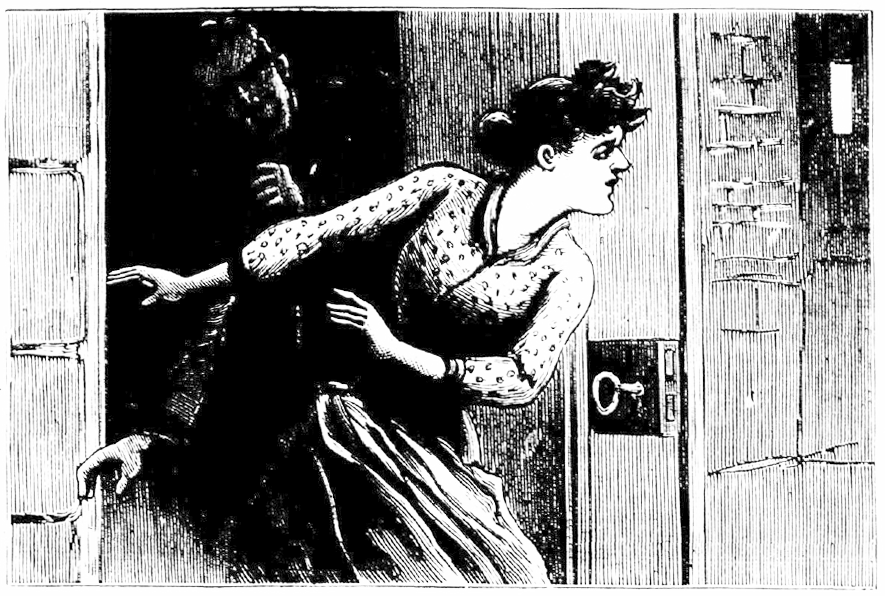
A little before dark on the evening of Sept. 9, a crowd of indignant women, numbering about forty; reduced the bagnio of the notorious “White Hat,” on Sixteenth street, Lafayette, Ind., to a complete if not picturesque ruin. It was a quiet but determined vigilante committee, and they did their work well. White Hat’s dive has long gloried in the reputation of the hardest place in Lafayette. It was a free for all. Race, color or previous condition of servitude was no bar. It was a cross between an old woman’s home and a pest house, and a stench to the nostrils of the neighborhood. The place has long been under police surveillance, and on the night mentioned above it was raided. The male guests scaled the back fence and fled, but four women, including White Hat, were run in. Next morning they were given thirty days apiece in jail. This episode left the establishment, for the time being, tenantless.

At a little after 4 o’clock the women of the neighborhood began to congregate on an adjacent corner. The news that the ranch was to be demolished spread like wildfire, and the crowd soon numbered two score. When it reached these dimensions the onslaught was made. A few determined women led the van and the rest streamed after, over the front yard. The house is a double brick, and the dive proper was in the south side. Here attentions were directed.

One of the women had an axe. She was about forty-five years old, tall, strong, and when she brought the blade against the panels they went in with a crash. A few more blows sent the door of its hinges. Almost a dozen of the boldest rushed in and began to demolish the interior, while the timorous contented themselves in throwing stones on the outside.

For a few moments it sounded like a fusillade of artillery, and in that length of time there wasn’t a piece of glass the size of a half dollar in any window in the establishment. Meanwhile several other axes had been brought into play and all the window frames and door cases splintered. Even the floor did not escape and was badly backed, while big chunks of plastering were knocked bodily out of the ceiling.

In the course of the afternoon most of the effects of the White Hat outfit had been removed on a dray, so there were but few household goods for the crowd to wreak their vengeance on. A cooking stove was the most conspicuous object, and this was speedily reduced to junk iron. Their work of ruin occupied in all about half an hour and the crowd then quietly departed. They did not stop to talk the matter over, but went straight home, and the demoralized house was the sole evidence of what had occurred. The work was viewed by a large crowd of men but none offed to interfere. They knew better.

The end of the trouble was not, however, in the event described above. At 9:10 in the evening an alarm of fire came in and called the department to the vicinity. Flames were seen braking through the roof of the dismantled edifice and rapidly spreading along the woodwork. The fire was obviously the work in an incendiary, as there had been no fire about the premises during the day. A little brisk work soon extinguished the blaze with a big hole burst through the shingles and considerable damage to the interior. It will take quite an outlay of money to put the property in anything like a condition to rent again. The fire is generally accepted as a final notification to the outfit that their presence will be no longer tolerated in Linnwood. It was said on the ground that the parties who fired the house are well known and will use dynamite the next trip if it is occupied again by the same kind of cattle.


Reprinted from The National Police Gazette, September 26, 1885.